TurningWaste into Wisdom
A bio-enzyme workshop series for Classes 6-12, where chemistry meets sustainability, and
classrooms become labs for the planet.
15+
Workshops Conducted
500+
Students Impacted
2
Tailored Programs
100%
Natural Science
Your School Is Already Required to Do This
India’s National Education Policy (NEP) 2020 mandates experiential learning, sustainability education, and real-world skill development as core
pillars for all CBSE schools. CBSE has further made Skill Education compulsory for Classes 6-8 from the 2025–26 academic session. Schools
are expected to provide hands-on, inquiry-based activities that connect classroom concepts to real-world application.
NEP 2020 specifically requires schools to instill in students “responsible commitment to sustainable development and living.” India is also
aligned to UN SDG 4 (Quality Education), SDG 12 (Responsible Consumption), and SDG 13 (Climate Action), all of which our workshop directly
addresses.
NEP 2020 Compliant
CBSE Skill Bodh Aligned
SDG 4 · SDG 12 · SDG 13
Experiential Learning
Competency Based
Zero-Waste Activity
Two Workshops.
One Mission.
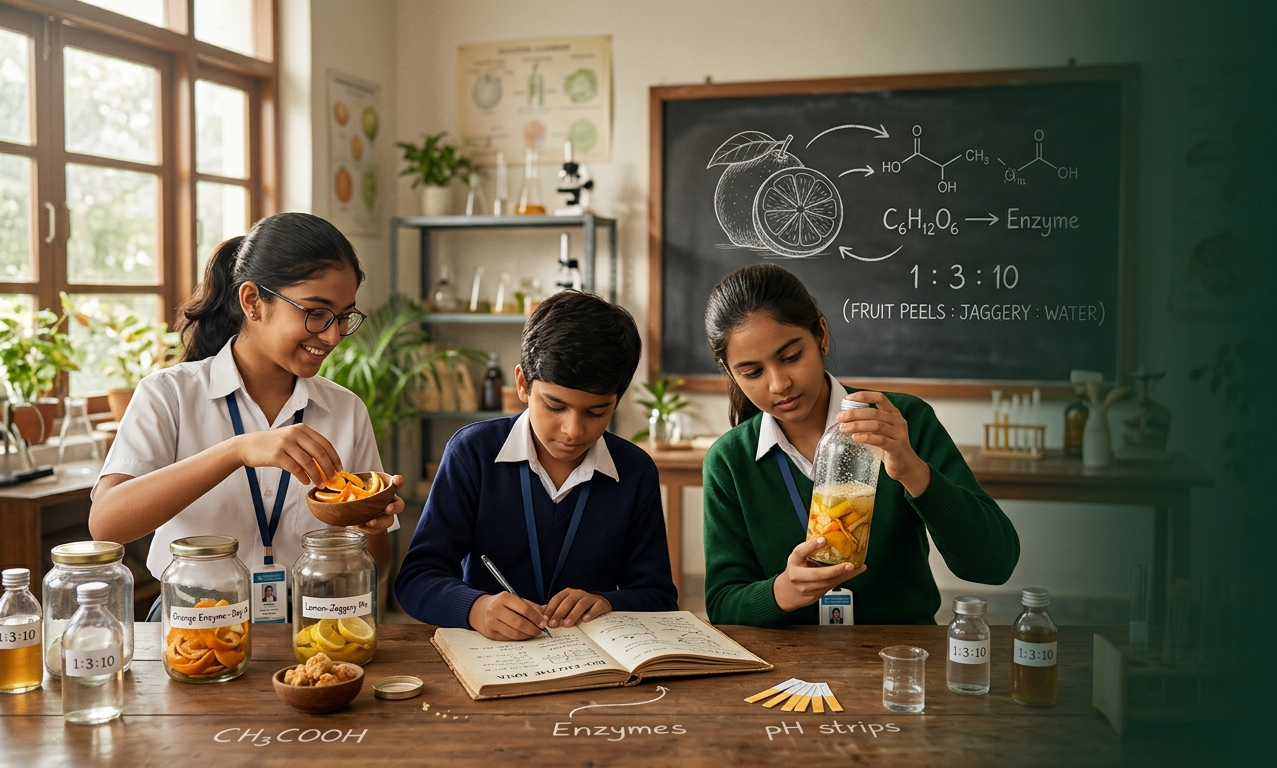
Designed for different levels of scientific maturity, both programs turn a simple bottle of fruit peels, jaggery, and water into a deep lesson in chemistry, biotechnology, and environmental responsibility.
Foundation Program
Young Scientists
Lab
Classes 6, 7 & 8
2-Hour Hands-On Workshop

What Is Bio-Enzyme?
Nature’s cleaning agent how fruit peels + jaggery + water
= powerful science
The Magic Ratio: 1:3:10
Hands-on mixing of jaggery, citrus peels & water;
understanding measurement and proportion
Fermentation in Action
Yeast, CO₂ bubbles, and the 90-day journey, simplified
for curious young minds
Chemical vs. Bio-Cleaners
Visual demo comparing SLS, bleach, vs. natural enzyme
cleaners, why it matters

Take-Home Starter Kit
Each student takes home their own bio-enzyme batch to
observe the full 90-day cycle
Advanced Program
Bio-Enzyme
Deep Dive
Classes 9, 10, 11 & 12
3-Hour Science + Sustainability Workshop
Biochemistry of Fermentation
Amylase, Protease, Lipase: how microbes secrete
enzymes and what they do at a molecular level
Microbiology at Home
Bacteria, yeast, anaerobic vs aerobic processes; phases
of 90-day fermentation cycle
pH, Acetic Acid & Preservation
Why the solution turns acidic, how pH drops to 3.5, and
how that prevents spoilage without preservatives
Biotechnology & Green Chemistry
Industrial enzymes, circular economy principles,
wastewater treatment, connecting science to career
pathways
Sustainability Math
500 homes × 10L chemical cleaner/month = pollution
math; calculating impact at neighborhood scale
Lab Session + Group Ideation
Brew their own batch, then ideate: how would you start a
sustainable cleaning brand? Pitching ideas.
The Science Behind It
Not Just Cleaning.
Real Chemistry.
Enzyme Cascades
Amylase breaks starch. Protease cuts protein. Lipase dissolves fat. Students learn exactly what each enzyme does and see it happen on a dirty dish. Direct curriculum connection to Class 10-12 Biology and Chemistry.
Living Fermentation
Microbes on fruit peels naturally colonise the sugar-water mix, producing CO₂ (observable), alcohol (Day 1-30), and then acetic acid (Day 31-90). A 90-day living science experiment students can watch at home.
Circular Upcycling
Waste citrus and pineapple peels, typically discarded, become a powerful cleaner. The leftover pulp goes back to compost. Zero net waste. This is the circular economy made tangible for 13-year-olds.

Green Chemistry
Principles
The workshop directly illustrates Principle 7 (renewable feedstocks) and Principle 10 (degradability) of Green Chemistry, aligning with the NCERT Class 12 Chemistry chapter on Biomolecules and Environmental Chemistry.

Real-World Data
Chemical cleaners leave behind benzalkonium chloride and SLS in wastewater for months. Bioenzymes degrade safely in days. Students calculate environmental load using real industry data applied mathematics meets ecology.
Sustainable
Mindset
Every student walks away not just knowing what bio-enzymes are, but understanding WHY they matter for their health, their family, and the planet. Science that creates lifelong consciousness, not just exam answers.
Minute-by-Minute
Program Design
Classes 6-8 · 2 Hours
0:00 – 0:20
The Big Why Hook
Show a bottle of chemical floor cleaner. Read out the ingredient list.
Now show a jar of bio enzyme.
Ask: which would you pour into your soil? Instant engagement.
0:20 – 0:45
What Lives in Your Kitchen Waste
Introducing microbes, fruit peels, and jaggery.
Explain the 1:3:10 ratio simply.
Students measure and mix their own bottles using the exact formula.
0:45 – 1:15
The 90-Day Journey: Animated Walkthrough
Day-by-day visual of what happens inside the bottle. Bubble demo.
Discussion of CO₂, alcohol, and vinegar.
Why you “burp” the bottle daily.
1:15 – 1:40
Live Cleaning Demo
Ready bio-enzyme vs. chemical cleaner on an oily tile or cloth.
Students observe and record which cleans better, no lab required.
1:40 – 2:00
Take Home + Q&A
Students label and take their own bio-enzyme starter bottle home.
Discussion: what will you tell your parents tonight?
Observation journal distributed.
Classes 9-12 · 3 Hours
0:00 – 0:20
Industry Reality Check
What is in your cleaning cabinet?
Decode ingredient labels, BKC, SLS, SLES, optical brighteners.
What happens to them after they go down the drain?
0:20 – 1:00
Biochemistry Deep Dive
Enzyme types, substrate specificity, anaerobic fermentation phases.
pH curve over 90 days.
Connecting to NCERT curriculum:
biomolecules, organic chemistry, microbiology.
1:00 – 1:30
Hands-On Lab: Brew & Measure
Students brew their own batch using the 1:3:10 formula.
pH testing of a ready batch.
Compare smell, colour, consistency at different stages of fermentation.
1:30 – 2:10
Sustainability Math & Biotech Careers
Calculate environmental load: chemical cleaner wastewater per family per year.
Green chemistry principles.
Career paths in biotechnology, environmental engineering,
sustainable product development.
2:10 – 2:50
Group Innovation Challenge
Teams of 4 design a bio-enzyme product, target customer,
use case, packaging, sustainable supply chain.
5-minute pitch to the class.
Winning team featured on Citpeels social media.
2:50 – 3:00
Certificate + Debrief
Participation certificates. QR code to Citpeels digital learning resources.
Students invited to document
their 90- day batch for a social impact project grade.
Why Citpeels
Not a Brand
Coming to Sell.
A Lab Coming to Teach.
Proven Track
Record
Citpeels has conducted 15+ bioenzyme workshops online, reaching 500+ students across India. We know what works in a classroom, the questions kids ask, the moments that spark curiosity.
Practitioners, Not Presenters
We formulate, brew, and sell bioenzyme cleaning products commercially. Our educators aren’t reading from a textbook, they’re sharing what they do every single day. Students can tell the difference.
Zero Sales
Agenda
The workshop content is entirely educational. We do not sell products to students during workshops. Our mission is to make one million Indian households aware of bio-enzymes, starting with young people.
Curriculum
Mapped
Every module is mapped to NCERT chapters in Chemistry, Biology, and Environmental Science for the relevant class group, making this a genuine academic supplement, not an add on activity.
Materials
Provided
All fermentation materials: citrus peels, jaggery, bottles, pH strips, observation journals , brought by Citpeels. Zero preparation burden on the school. We set up, we clean up.
SDG
Documentation
We provide schools with a postworkshop report documenting how the session fulfilled NEP 2020 experiential learning requirements and SDG commitments, useful for SQAAF accreditation and school annual reports.
Born from a
Kitchen Counter.
Citpeels (CitPeels Naturals Pvt Limited) is a bio-enzyme cleaning products brand built on a simple belief: the cleanest clean shouldn’t cost the planet anything.
We make floor cleaners, dishwash liquids, and household sprays, all from fermented fruit peels, Himalayan soap nuts, and therapeutic-grade essential oils. Not one synthetic chemical. Not one drop of SLS, BKC, or artificial fragrance.
The same philosophy that goes into our bottles goes into our classrooms. We’ve been educating online for two years. Now we’re bringing it offline, to school labs across India, one workshop at a time.
15+
Online workshops conducted
500+
Students trained
90
Day fermentation cycle
taught
100%
Natural ingredients used
0
Synthetic chemicals in our formulations ever
The Offer
Everything Your School
Gets Out of This.
| Deliverable | Classes 6–8 (2 Hr) | Classes 9–12 (3 Hr) |
|---|---|---|
| Live educator-led workshop session | ✓ | ✓ |
| All fermentation materials (peels, jaggery, bottles) | ✓ | ✓ |
| Take-home bio-enzyme starter kit per student | ✓ | ✓ |
| Student observation journal (90-day tracker) | ✓ | ✓ |
| Curriculum-mapped module reference sheet | ✓ | ✓ |
| Participation certificates for all students | ✓ | ✓ |
| pH testing & lab instruments | – | ✓ |
| Group innovation challenge & pitch session | – | ✓ |
| NEP/SDG compliance documentation for school | ✓ | ✓ |
| Post-workshop digital resources (QR access) | ✓ | ✓ |
| Winner featured on Citpeels social media | – | ✓ |
Ready to Make Your School a Lab for the Planet?
Schedule a free 20-minute call with our Education Team. We’ll customise the program for your school’s class size, curriculum, and calendar.